
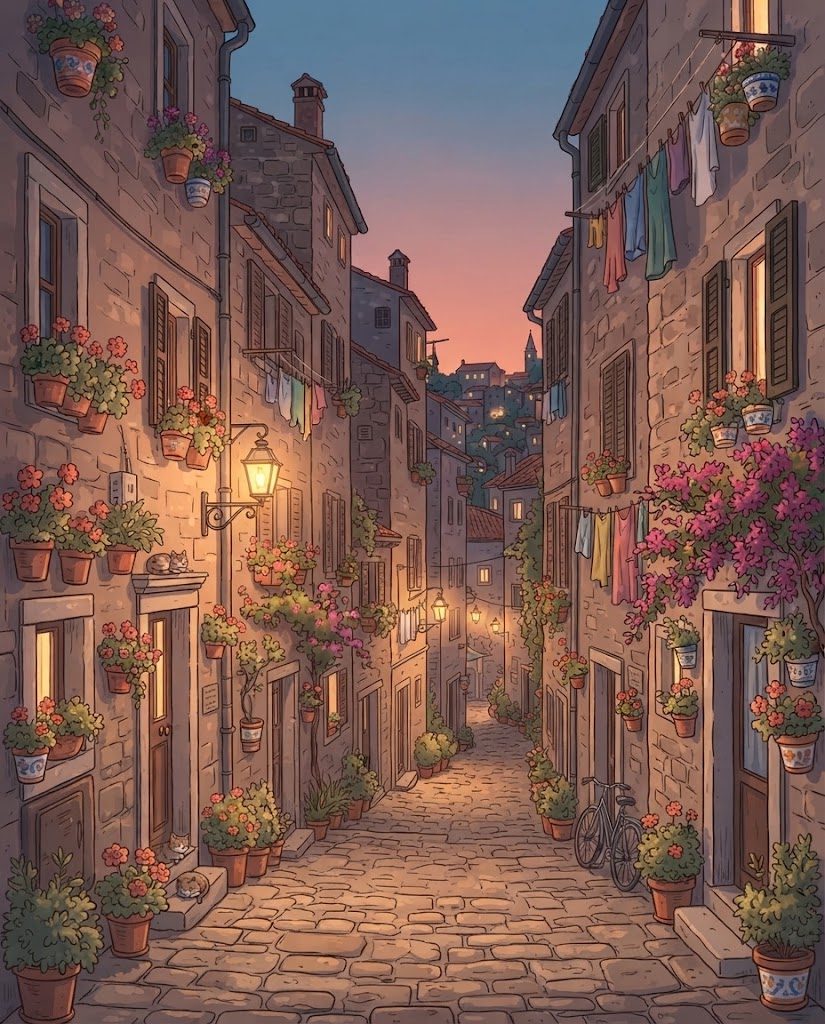
Tribunj is one of those Dalmatian towns whose history isn’t just written in books, but embedded in the very structure of the settlement – in the narrow islet connected by a stone bridge, in the walls that once protected its people, and in traditions passed down through generations. For guests of Summer House Le Vito, understanding this story makes a stay in Tribunj a much richer experience.
An Islet as the Foundation of the Settlement
What we experience today as the old core of Tribunj actually originated on a small islet, later connected to the mainland by a stone bridge. This relocation of the population to the islet took place during the Venetian-Ottoman wars, when rural inhabitants from the nearby Jurjevgrad and surrounding fields took refuge in a safer place surrounded by defensive walls. That densely packed construction, with narrow streets and houses built right against one another, left its mark on the appearance of Tribunj as we recognize it today.
Origin of the Name – Several Theories, One Story
The name Tribunj changed over the centuries – old records mention it as Trebić, Trebunj, Tribohunj, Tribohum, and in 17th-century Venetian documents as Trebocconi. There are several theories about the origin of the name: one links it to a pagan deity of the autumn sun among the ancient Croats, another derives it from a word meaning “place of sacrifice,” while a third connects the name to a Venetian term referring to three parts of the settlement. The place is first mentioned in written sources at the end of the 14th century, though it likely existed earlier – older records were lost in an attack on nearby Šibenik.
Jurjevgrad and the Hill Above the Settlement
Before life centered on the islet, the area was dominated by Jurjevgrad – a fortress on the hill above present-day Tribunj. Today, a small church dedicated to St. Nicholas (locals also call it St. Mikula) stands on that site, surrounded by an old cemetery, with a view encompassing the entire town, the nearby islets, and the sea. A short walk to the top of the hill remains one of visitors’ favorite activities for experiencing Tribunj’s historical layer.
A Town Encircled by Stone
The walls that once surrounded the islet and protected its inhabitants remained visible until the early 20th century. The Italian travel writer Alberto Fortis, who traveled through Dalmatia in the late 18th century, described Tribunj as a small, walled village connected to the mainland by a stone bridge – an image that, aside from more modern infrastructure, has essentially been preserved to this day in the old town core.
A Life Built on the Sea and Olives
The traditional occupations of Tribunj’s residents were fishing and olive growing – two trades that shaped the rhythm of life in this region for centuries. The fishing tradition is still celebrated today through events like Fishermen’s Night, while the old olive groves in the surrounding area bear witness to a long history of olive cultivation. These elements remain visible in daily life today, as well as in local cuisine.
The Donkey Race – A Symbol of Identity
One of Tribunj’s most recognizable traditions is the donkey race, held for more than half a century since the 1950s. The donkey was long an indispensable working animal in this region, helping locals with agricultural work and transport, so the race today symbolically celebrates that historical role. A monument to the donkey, placed in the town itself, testifies to the importance of this tradition for Tribunj’s identity.
Tribunj Today – A Living Heritage
Tribunj became an independent municipality in 2006, separating from neighboring Vodice. Despite modernization and tourism development, the old core on the islet, the stone bridge, the hilltop church, and traditional events still preserve the spirit of the town as shaped over centuries. For guests staying at Summer House Le Vito, this history isn’t just a story from books – a short walk to the old core is enough to feel, layer by layer, the identity of this small Dalmatian town.
Conclusion
The origins of Tribunj – from a refuge on an islet, through centuries of fishing and olive growing, to today’s iconic donkey races – is a story of a community that knew how to preserve its identity despite the challenges of history. A stay at Summer House Le Vito offers the chance not just to read this history, but to feel it – through the narrow streets of the old core, the view from Jurjevgrad hill, and traditions still celebrated every year.