
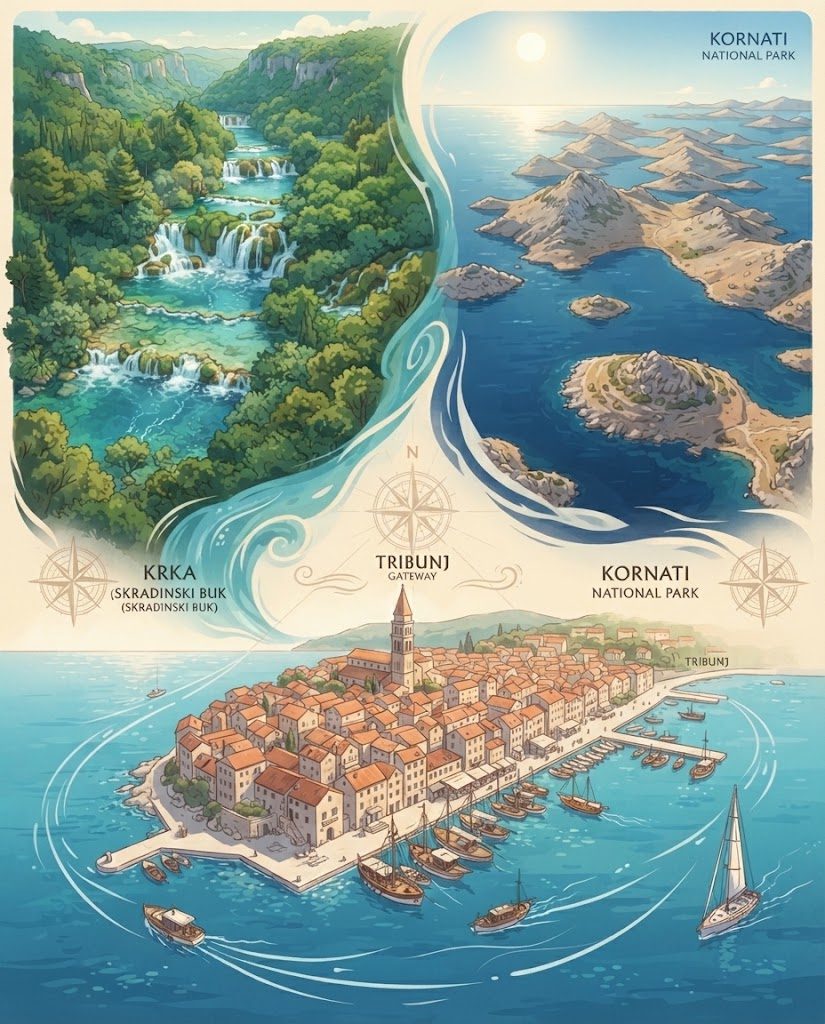
Tribunj sits on a small stretch of the North Dalmatian coast, yet it puts two of Croatia’s best-known national parks within easy striking distance. Stay in this fishing village on the Šibenik Riviera and you’re close enough to Krka National Park’s waterfalls to visit on a half-day, and near enough to the Kornati Islands to reach them by boat without an early alarm call.
That combination is rarer than it sounds. Plenty of Adriatic towns claim to be “central”, but Tribunj’s position in Dalmatia, Croatia, means the logistics for a land-based waterfall day and a sea-based island day are both genuinely manageable, not just theoretically possible.
If you’re weighing up Tribunj against a base in Vodice, Šibenik or Murter, the deciding factor is usually how much you value a quiet overnight stay balanced against comparable access to Krka and Kornati. This piece looks at what that trade-off actually involves, from marina logistics to swimming rules at Skradinski Buk, so you can plan the trip days properly before you arrive.
Why Base Yourself in Tribunj?
Tribunj works as a base because it combines a sheltered marina, quiet fishing-village character and fast road links, all within Šibenik-Knin County. It sits close enough to Vodice and Murter to borrow their amenities without absorbing their crowds.
Where Is Tribunj on the Šibenik Riviera?
Tribunj lies on a narrow headland a short drive north of Vodice, connected to the mainland by a stone bridge that leads into its old fishing quarter. The town itself is compact, built around a small island core, with the modern part spreading along the coast towards Šibenik.
Murter island sits close by across the water, and this proximity matters for boat trips, since Murter is one of the standard launch points for Kornati excursions. Tribunj’s setting between Vodice and Murter puts it inside the same pocket of coastline as several of the region’s departure points, without the density of hotels found in the bigger resorts.
What Makes the Marina and Road Links Useful?
Marina Tribunj gives sailors a sheltered, well-run base described as one of the better-kept marinas on this stretch of coast, and it doubles as a practical starting point for both national parks. It sits in a protected bay, and staff there can arrange admission tickets for Krka National Park directly, which saves a stop elsewhere before setting off.
By road, Tribunj connects to the wider region within minutes rather than hours. Šibenik is roughly 10 km away, giving access to bus lines and the fast ferry that link the town with major cities across Europe, according to a local accommodation guide. That means visitors without a hire car still have a workable route in and out for day trips or onward travel.
How to Visit Krka National Park From Tribunj
Krka National Park is reachable from Tribunj by car in well under an hour, and the Krka River’s waterfalls, most famously Skradinski Buk, are the main draw. The park sits inland from Šibenik, with Skradin as its most convenient gateway from the coast.
The distance from Tribunj to the park’s edge near Skradin is around 20 km, with the Krka River carving a series of cascades along its karst canyon, according to Tribunj’s own excursions guide. By boat, sailing to Skradin along the coves and channels takes about 45 minutes, based on a Tribunj nautical guide, which makes a half-day sailing visit realistic for those already on the water. By road, some routes from Tribunj to the park take as little as 29 minutes, with fares from around $5, according to Rome2Rio’s route data.
Which Entrance Should You Use: Skradin or Lozovac?
Skradin is the better entrance for anyone travelling from Tribunj without their own transport, since it’s reachable by boat and sits directly on the water, feeding into the park via a shuttle boat along the river. Lozovac, the upper entrance, suits drivers heading in from inland, with its own car park and a shuttle bus down into the canyon.
Both entrances lead to Skradinski Buk, the park’s signature waterfall system, but Skradin has more charm as a stopover in its own right, with cafés and a working harbour to explore before or after the walk. If you’re driving from Tribunj, check current signage at Lozovac since the shuttle bus timetable there can affect how long the transfer takes.
What Can You See Beyond Skradinski buk?
Roški Slap is the second major waterfall area worth building into a longer visit, reachable by the park’s internal boat trips further upriver from Skradinski Buk. Visovac Island, with its Franciscan monastery, sits between the two and is often included on organised boat tours through the park.
Swimming at Skradinski Buk has been restricted in recent seasons as part of efforts to protect the waterfall’s ecosystem, so check the latest rules before planning a dip there. Further upstream, near Roški Slap and around some of the park’s lakes, swimming areas have historically been more relaxed, though this varies by season and park management decisions, so confirm current restrictions before setting off. Knin, at the park’s northern edge, adds a detour for those interested in its fortress, but it isn’t essential for a first visit focused on the waterfalls themselves.
Planning a Kornati Islands Boat Day
A Kornati Islands day trip from Tribunj means booking a place on an organised boat excursion or chartering a private boat, since the archipelago has no scheduled public ferry service from the town. Kornati National Park is a dramatic, largely uninhabited scatter of islands, and reaching it is entirely a sea-based exercise.
The Kornati archipelago includes around 89 islands, islets and reefs according to D-Marin’s overview of the region, with other counts putting the figure closer to 80 depending on how minor rocks and reefs are classified. Either way, this is one of the Mediterranean’s most concentrated island groups, and a full-day boat trip is the standard way to see a meaningful slice of it.
Should You Depart From Tribunj or Murter?
Murter is the more established departure point for Kornati trips, with a larger fleet of excursion boats and more frequent sailings, but Tribunj offers a quieter alternative with its own boat rental and excursion operators. Local companies in Tribunj, including day-cruise operators running traditional wooden boats through the Šibenik archipelago, run trips that combine Kornati with nearby waterways, according to one local excursion listing.
Departing from Tribunj usually means a slightly longer approach to the national park boundary than from Murter, since Murter sits closer to the archipelago’s edge. For most visitors the difference amounts to twenty or thirty minutes of extra sailing, which is a fair trade for staying somewhere quieter overnight.
What to Expect in the Kornati Archipelago
Expect stark, pale limestone islands with little vegetation, dramatic cliffs on the seaward side and sheltered bays used for swimming stops and lunch. Kornat itself is the largest island in the group, and Piškera is a well-known anchorage with a small marina and restaurant, often used as a stopping point on full-day tours.
Most organised excursions build in two or three swimming stops, a lunch break in a working restaurant bay, and time to explore one of the island’s dramatic cliff faces from the water. Diving is popular here too, with several operators running dedicated trips into the park’s clearer offshore waters. Given the national park entry fee and limited facilities on most islands, packing water and sun protection matters more here than on a standard beach day.
More Things to Do Between Excursions
Tribunj itself rewards a slow half-day, and the surrounding islands and towns add enough variety that not every day needs to revolve around Krka or Kornati. Its old-town island core, small beaches and easy ferry links to nearby islands make it a good base for rest days between bigger trips.
What Should You See in Tribunj Itself?
The old town, built on a small island connected to the mainland by a stone bridge, is the heart of Tribunj’s character, with narrow lanes, the church of St Nicholas and waterfront restaurants clustered close together. It’s compact enough to explore fully in an hour, longer if you stop for coffee by the marina.
Zamalin Beach is the most convenient swimming spot near the centre, a shingle and rock beach a short walk from the old town. For a bigger day out, Šibenik is close enough for an afternoon visit, with its UNESCO-listed Cathedral of St James drawing visitors into the historic core, and Amadria Park nearby offering a water park option for families wanting a change of pace from boats and beaches.
Which Nearby Islands and Towns Add Variety?
Zlarin, Prvić, Krapanj, Kaprije and Žirje are all reachable by ferry from the Šibenik area, each offering a different flavour of island life, from Zlarin’s car-free lanes to Krapanj’s sponge-diving history. These make good half-day trips for anyone wanting to see more of the archipelago without a full boat charter.
Zadar and Split both sit within range for a longer day trip, though the return drive from either adds a fair amount of time to the day. Prvić in particular is a favourite for a relaxed island lunch, close enough to combine with a morning in Tribunj.
When to Go and How to Plan Your Days
May, June and September give the most comfortable balance of warm Adriatic weather and manageable crowds for both Krka’s boardwalks and Kornati’s boat trips. July and August bring the busiest queues at Krka’s entrances and the fullest excursion boats heading into the Kornati archipelago.
When Are Boat Trips and Waterfall Visits Most Enjoyable?
Early starts make the biggest difference to how enjoyable both excursions feel. Arriving at Krka’s Skradin or Lozovac entrance before mid-morning avoids the worst of the coach-tour crowds, while Kornati boats that leave by 8am or 9am reach the better anchorages before they fill up.
Midsummer heat makes the shadeless walkways at Skradinski Buk and the exposed decks of Kornati excursion boats harder going by early afternoon, so building in shade breaks and water matters more from July onwards. Shoulder-season visits in late spring and early autumn keep temperatures comfortable for the national parks’ boardwalks and beaches alike.
How Many Nights Do You Need in Tribunj?
Four to five nights gives enough time for one Krka day, one Kornati day, a Šibenik or Zadar excursion, and at least one day left free for the beach or a nearby island. Shorter stays of two or three nights force a choice between the parks, since fitting both in without a rest day feels rushed.
Longer stays of a week or more suit sailors and families who want to add Split, Trogir or one of the smaller Dalmatian islands into the mix without cramming the schedule.
A Relaxed Base for Waterfalls and Island Escapes
Tribunj earns its place as a base through genuine convenience rather than hype: a sheltered marina, a compact old town, and realistic travel times to both Krka National Park and Kornati National Park. A Krka day works well by road or boat via Skradin, while a Kornati day depends on booking a boat excursion or charter, whether departing from Tribunj itself or the slightly closer Murter.
Choosing Tribunj means trading some of Vodice’s or Šibenik’s buzz for quieter evenings on the marina front, with both national parks still comfortably within a day’s reach. For travellers who want fishing-village calm alongside genuinely workable access to waterfalls and islands, that trade-off is the whole appeal.